By Cyndy Jean, Ed.D., Associate Head of School, Hackley School
Recently, I found myself reflecting on one of Hackley’s core values — “Character is higher than intellect” — as I thought about why I feel so lucky to have my children enrolled in the Lower School.
To illustrate my point thoughtfully, however, it may be helpful to share short descriptions of my two children.
My daughter is a “rule warrior.” She delights in structure and confirms and reconfirms what she is and is not allowed to do throughout every second of the day. She is also quite comfortable reporting to me when her brother breaks the rules at home. She believes in justice and fairness, and will advocate for those she believes have been hurt or treated unkindly. My second child, the rule breaker, was put on this earth to connect with people. He loves his friends fiercely, enjoys being in the company of others, and will happily pack away a small treasure for a friend at school if he knows it will make them happy. He is the one ready and willing to defend his older sister and will, without prompting, jump in bravely to help her if he sees her struggling or sees her afraid of the phantom bug floating by.
When my children began at Hackley’s Lower School, they instantly felt seen and valued there. The structure, the rules and the kindness they immediately experienced affirmed parts of their identity and quickly allayed any fear or concerns they had about transitioning from home to school on a regular basis. My children would come home and recount the stories of the new best friends they made and the incredible facts they learned throughout the course of the day. Hackley felt like the right place to be not merely because they were growing in intellect, but more importantly because they were growing in character, and the pillars of character education were central to their experiences.
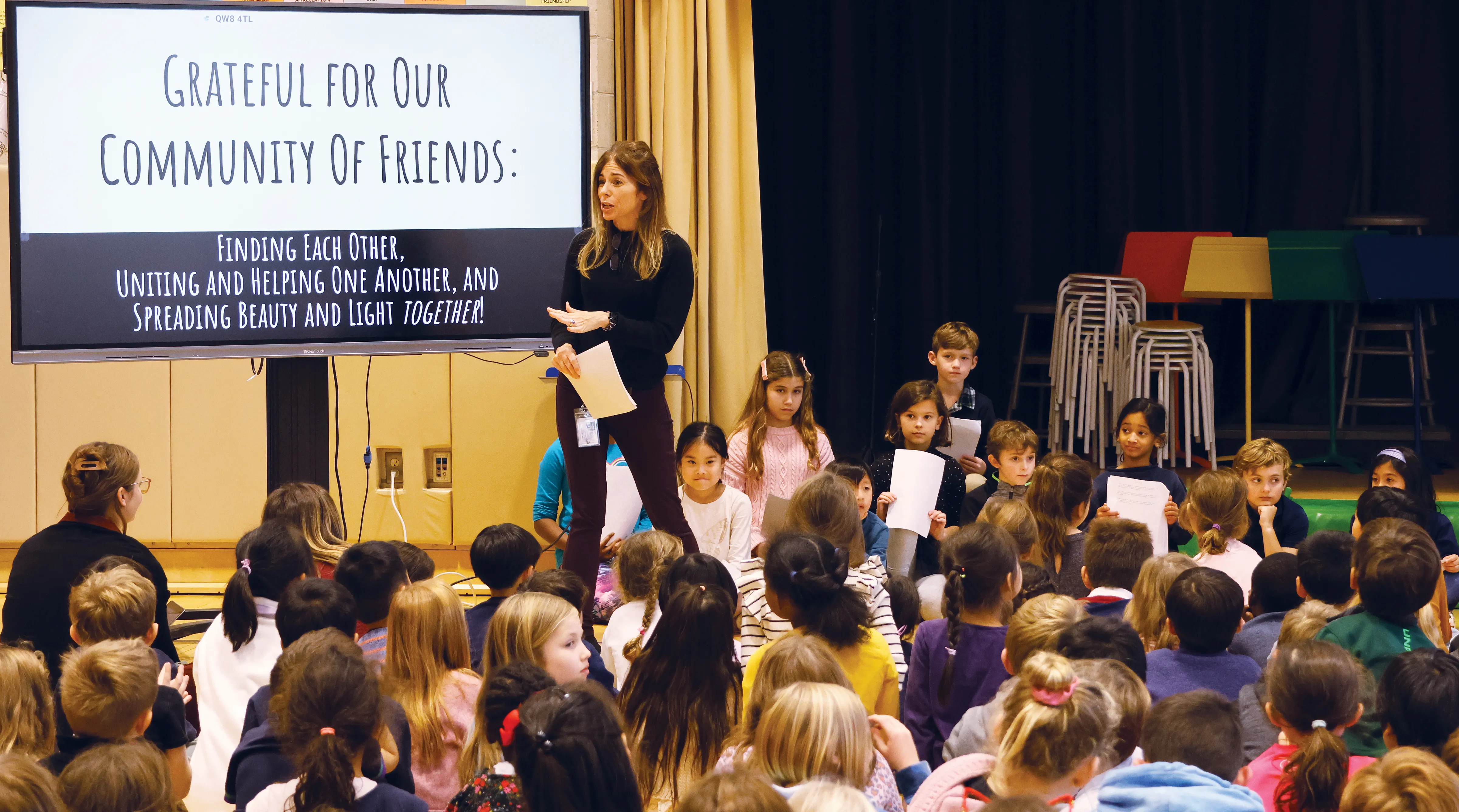
Lower School students gather for a Character Education assembly centered on the virtue of “community.”
The Lower School team has taken a carefully crafted approach to establish the character education program. The bi-monthly assemblies on a character virtue — this year, namely, community, perspective, courage and sportsmanship — allow students to come together to learn about the definition of these words, how they can apply the virtues, and why they are important. At the conclusion of each assembly, Ms. Rachel Mwakitawa selects a picture book to share with the students to further illustrate the themes and connections to each character virtue. Additionally, classroom teachers apply the lessons from Second Step and Responsive Classroom to support the social-emotional growth of each child in the Lower School.
These lessons empower our youngest learners to use the necessary words to express their emotions and to stand up for their peers. Hackley believes that this approach to character education sets the foundation for students to be successful well beyond their formative years in the Lower School.
It also opens a door for continued dialogue related to character education as our students progress throughout the School.
At Hackley, we say “character is higher than intellect,” a phrase borrowed from Ralph Waldo Emerson’s speech, “The American Scholar,” within which he argues that genius is cultivated when we balance “reading books with reading life.” Emerson states (Essays and Lectures, taken from Popova, “The Marginalian”):
Character is higher than intellect. Thinking is the function. Living is the functionary. The stream retreats to its source. A great soul will be strong to live, as well as strong to think. Does he lack organ or medium to impart his truths? He can still fall back on this elemental force of living them. This is a total act. Thinking is a partial act… The scholar loses no hour in which the man lives.
Emerson opines on character, and his resolutions feel relevant today as school leaders grapple with the complexities we are seeing around the world. What will be the impact of artificial intelligence on a student’s learning? What is the role of moral courage in a divided world? How might we lean into the great thinkers of the past to understand the matters presently at hand and work toward building solutions? How might one examine their own life to articulate stories that bridge across identities, and what are the skills needed for an effective practice of self-reflection? I believe that Emerson presents us with language to explore the answers to these questions.
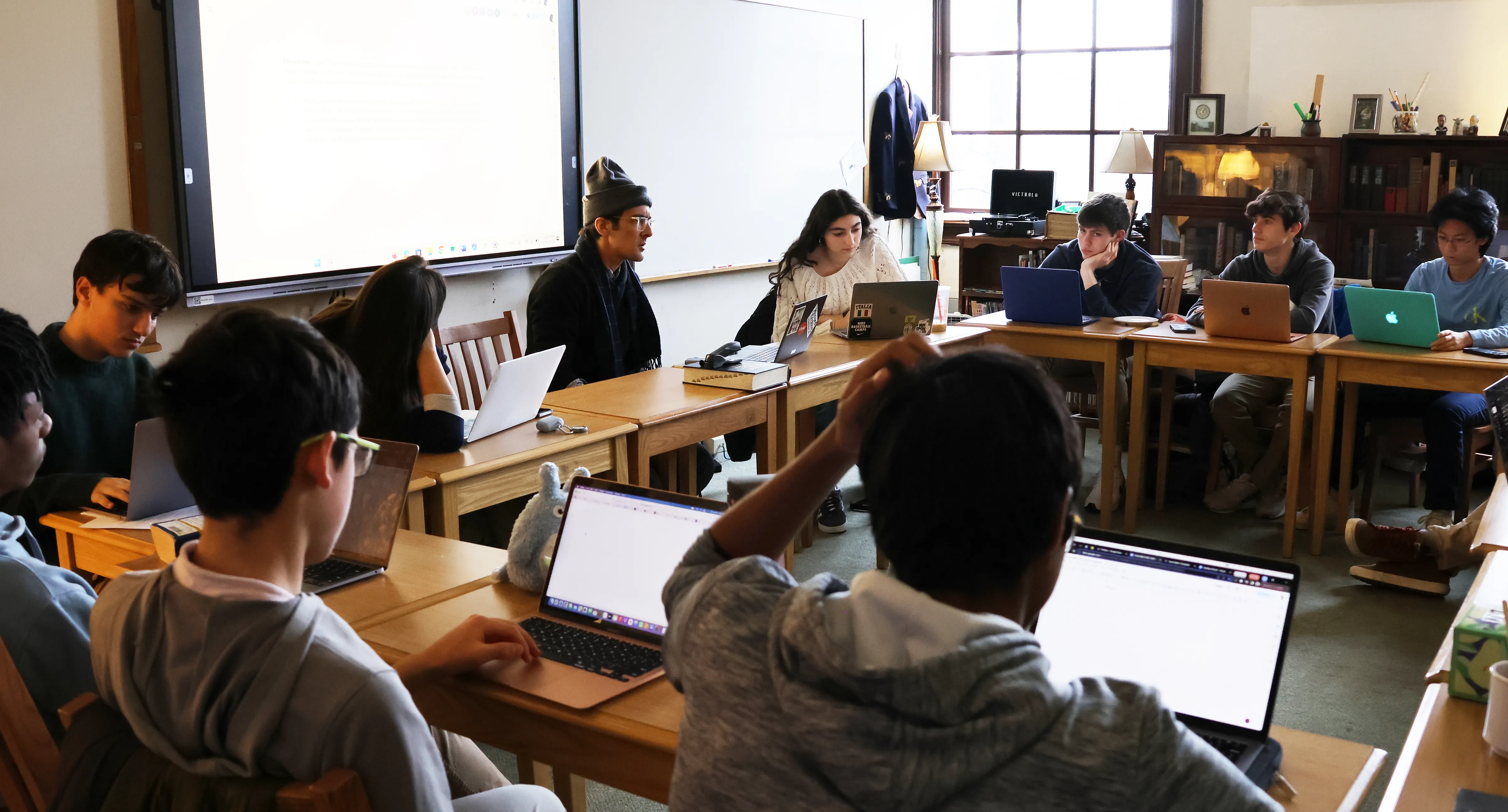
Upper School students engage in a moment of reflection.
It is our job to help Hackley students in our care maintain a balance of character and intellect in order to reason through the questions before them. In these complicated times in which we are living, I argue that Emerson’s position is relevant and necessary. Character and intellect must go hand-in-hand if we desire to bring forward a generation of deep critical thinkers and inspiring leaders. Our students must engage in collaboration, ask the hard questions and practice self-reflection in order to live in the experience of learning. In doing so, “the stream retreats to its source.” Collaboration, a willingness to listen to other perspectives, and employing the right tools to offset challenges are character building moments, which are vital to success as a learner. Dr. Martin Luther King Jr. writes in the Morehouse College Paper (1947), “The function of education, therefore, is to teach one to think intensively and to think critically. But education which stops with efficiency may prove the greatest menace to society” (morehouse.edu).
Recently, I overheard my daughter and son sharing stories about their day. When my daughter completed her thought, my son asked, “You know who is smarter than me? My best friend. He’s the best reader in class. I like when he reads me stories.” In his very kindergarten way, my son illustrated to me that being the best reader was not the most important. It was sharing the experience of reading with his best friend that brought him joy — and I can say it is also what has motivated him to improve his reading skills! The balance of character and intellect creates a “total act of living,” one that we want for the graduates of this incredible institution.
About the author: Cyndy Jean, Ed.D. P’34, ’36 is Hackley’s Associate Head of School. She earned her bachelor’s degree at Amherst College, master’s in teaching at Fordham University, master’s in education at Teachers College at Columbia University, and her doctorate from the University of Pennsylvania. Cyndy joined Hackley School as an assistant teacher and has worked as a coach, division director and grade-level dean.