By Charles Franklin, Head of School, Hackley School
There has been no shortage of news recently regarding the impact of smartphones and social media on young people.
From Jonathan Haidt’s excellent book The Anxious Generation to Governor Hochul’s announcement that she is examining banning phones in New York public schools to countless op-eds and podcasts, it is clear that there is significant interest in restricting smartphone access for students while at school.
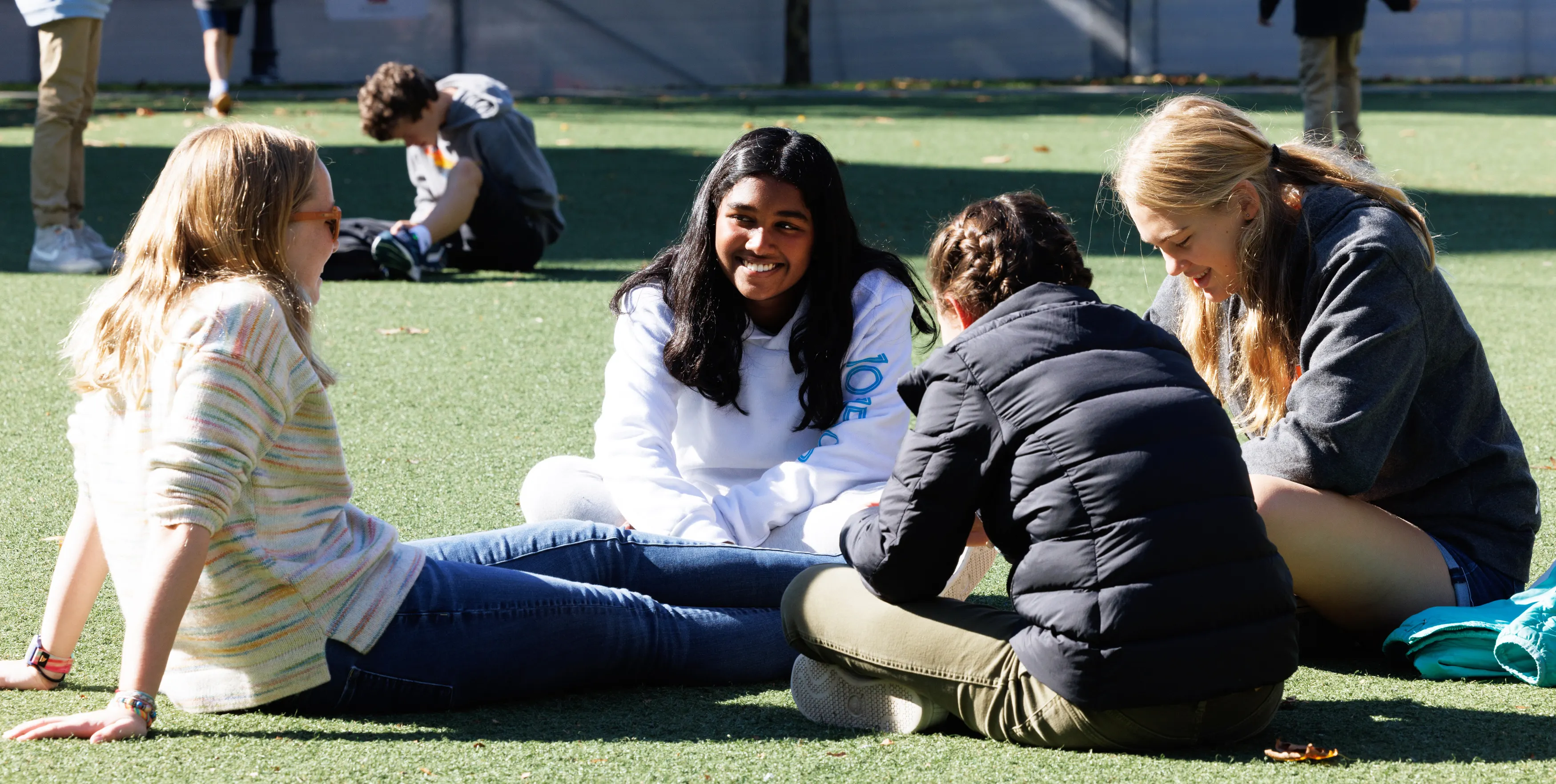
Students connect on Akin Common during a free period.
Having worked in school communities my entire professional life, I have seen firsthand how young people derive meaning and purpose from their sense of connection with others. We know this is true, not only from decades of neuroscience and psychology research, but also from the collective experience of COVID lockdowns where human connection was disrupted in an unprecedented manner.
In speaking to the Upper School during the first week of school, I asked our students to think of an accomplishment they felt particularly proud of. I told them it could come from any realm — academics, arts, athletics, community service, family, etc. — and then I asked them to raise their hand if their accomplishment in some way involved other people. As you might guess, nearly every hand went into the air.
Feeling connected to others is an essential ingredient in finding meaning, purpose and joy in our lives.
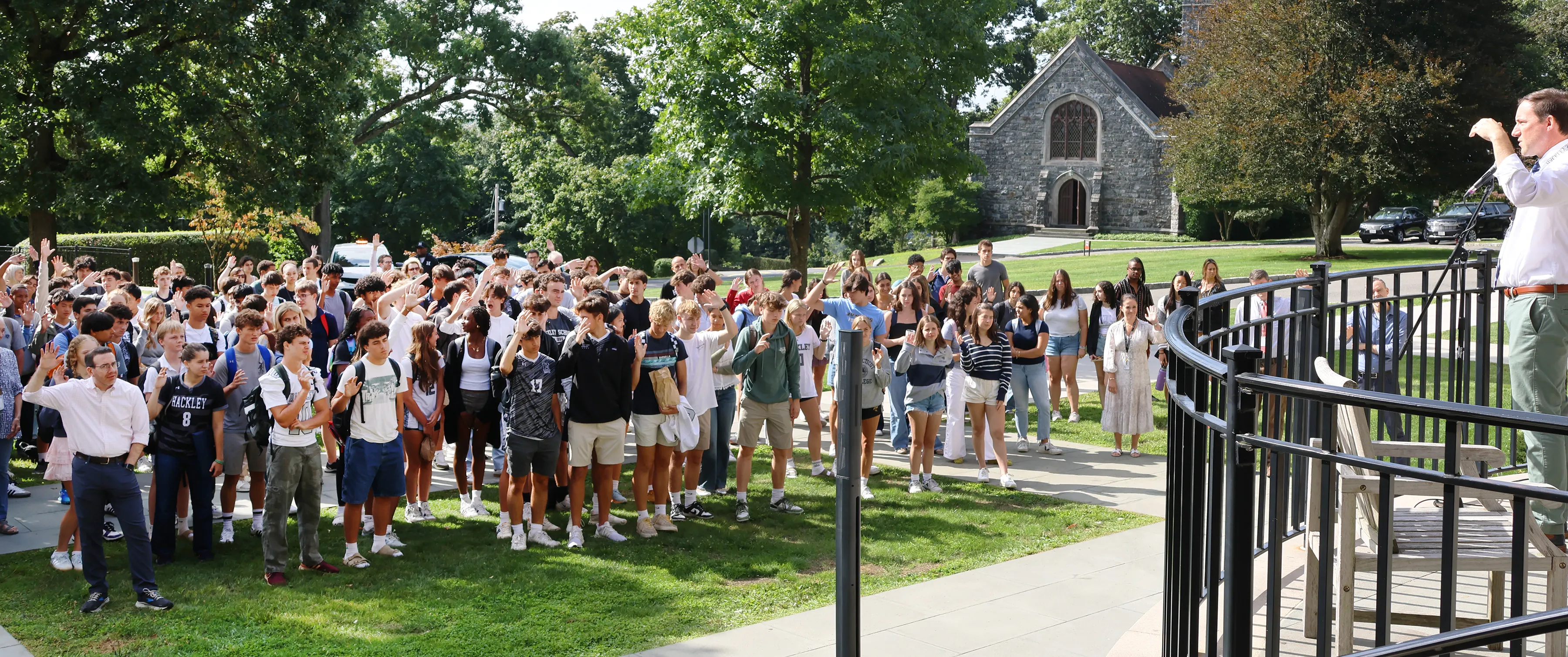
Head of School Charles Franklin asks students to think of an accomplishment they felt particularly proud of during the first week of the 2024–2025 academic year.
Detailing all the academic and developmental arguments for why smartphones and social media have deleterious effects on young people would take much longer to flesh out than we have space for here. There is one statistic, however, that has stood out in my thinking about smartphones and social media with regard to our students.
For the last 20 years, the United States Bureau of Labor Statistics has been compiling an annual “American Time Use Study” (ATUS) that, as the name suggests, tracks how Americans use their time on a daily basis. From when the survey began in 2003 until the most recent results were shared in 2023, American teenagers have experienced a 45% decline in the amount of time they are face-to-face with another human being. The rise of screen time and the decline in time spent socializing in-person with friends in high school (something which coincided with the proliferation of smartphones and social media, not with COVID-era lockdowns) has meant that American teenagers are having dramatically fewer face-to-face interactions with other people as compared with all previous generations.
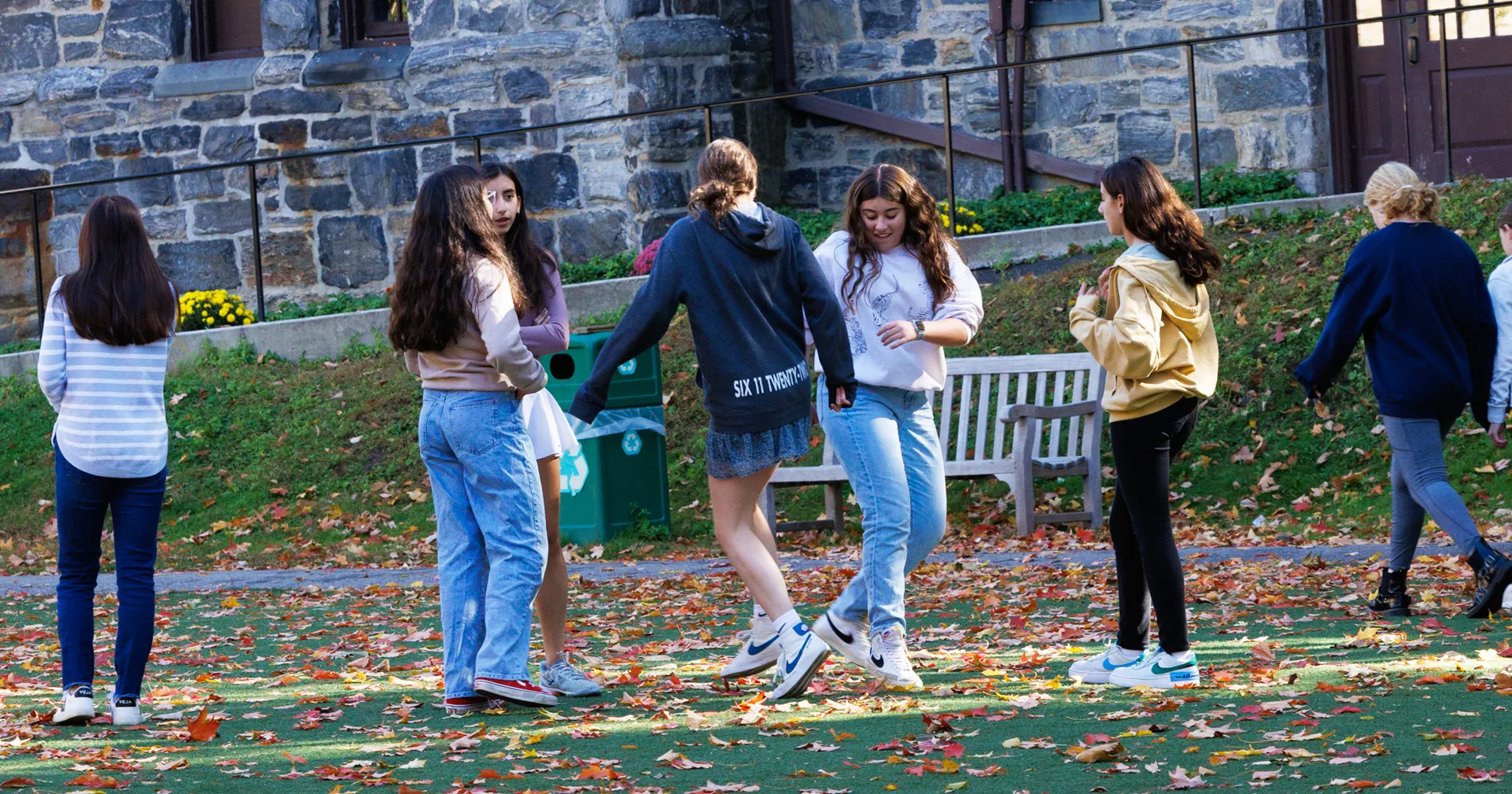
Students having fun together on Akin Common.
In speaking with students about this development, I often ask, “What do you think would happen to your French speaking skills if you spent 45% less time speaking French? Or what would happen to your ability to hit a softball if you spent 45% less time in the batting cage? Or 45% less time practicing the violin?” Students intuitively respond that they would be worse linguists, athletes and artists.
Note 1: A slight digression here — while time on task is an aspect of acquiring new skills and mastery, I want to be careful to not overemphasize this point. One of the best books of the past five years is David Epstein’s Range: Why Generalists Triumph in a Specialized World. In it, Epstein masterfully demonstrates that hyper-focusing on one domain is not the pathway to success in the vast majority of human endeavors.
So what do our students lose with this precipitous decline in time spent with other people? I would argue that young people are losing out on:
- The ability to read human facial emotions;
- The ability to ask questions to sustain a conversation, developing an inquisitiveness about the lived experience of others;
- The ability to empathize with the experiences of others;
- The ability to verbalize one’s own feelings with others;
- The ability to modulate and regulate one’s views;
- The ability to discern limits and boundaries; and
- The ability to form shared memories and experiences.
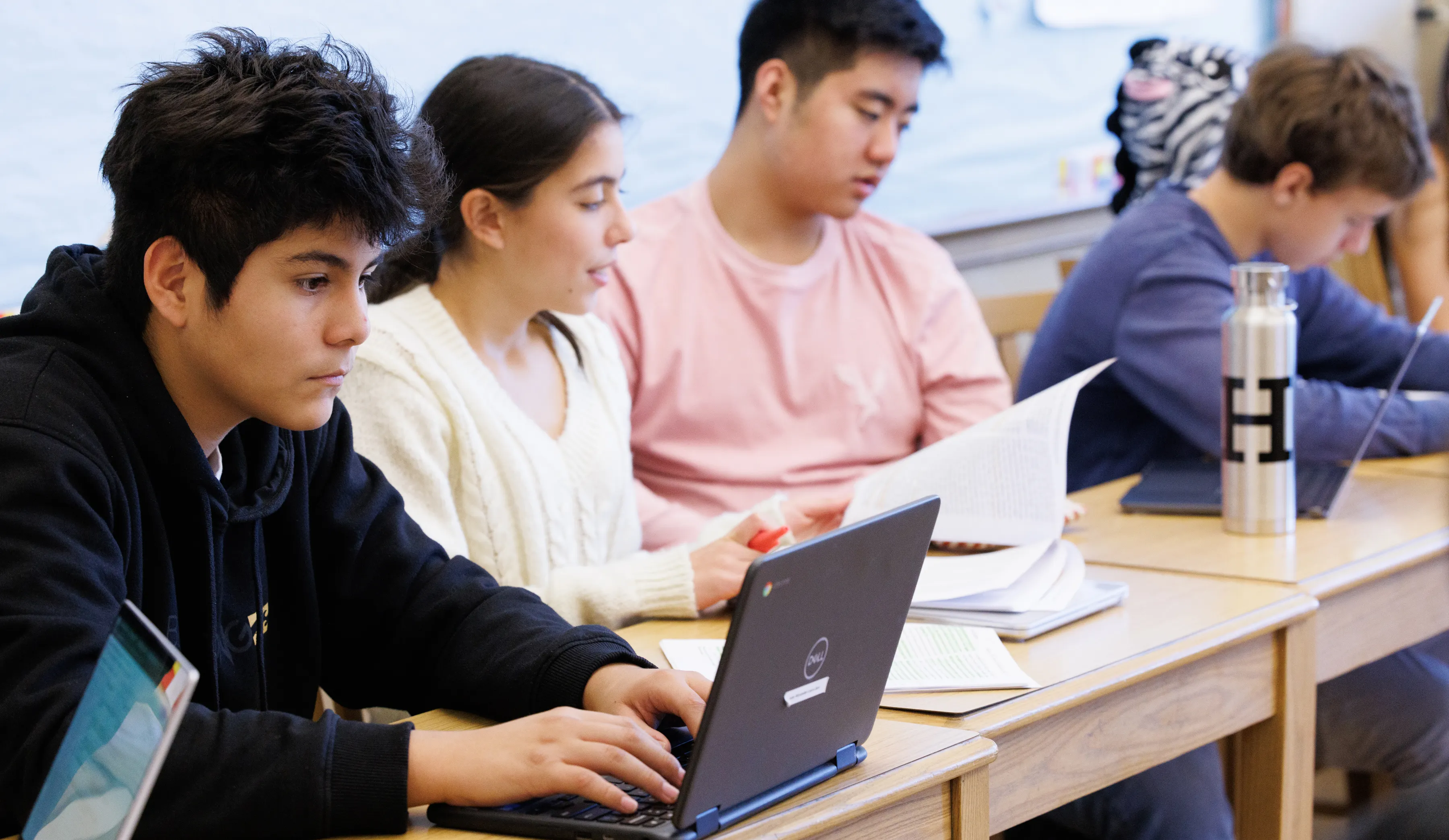
Upper School students engage in their learning.
At Hackley, our students and faculty have done an excellent job of building a culture of focused engagement in the classroom. Whereas a main thrust of Governor Hochul’s efforts are aimed at removing the distraction of cell phones from lessons being taught in the classroom, we have a different first priority. We have that luxury, as our students do not use their cell phones during class.
Note 2: I am sure there have been rare instances where this is not the case, but generally speaking, our classrooms are free of cell phone usage — a credit to both our faculty and our students.
However, it is in our hallways, dining halls, lounges and outdoor spaces that I saw the impact smartphone use had on our community during the 2023–2024 school year. Many students were not on their phones or listening to music as they made their way between classes or during lunch, but enough had made this a habit of their time here on the Hilltop to be concerned about the impact on our community and culture. Upper School students’ heads were sometimes down at lunch as they looked at their phones instead of connecting with peers. I would occasionally pass an Upper School student walking across campus wearing headphones and say hello, only to receive nothing in return as the student had not heard me and didn’t recognize my interest in a greeting or conversation. This is not what we want for our community.
What we want is for each and every student at Hackley to give their undivided attention to their education, their peers, their teachers and their school. We want them to form relationships with as many people as possible — people in different grades and people with different backgrounds.
Being fully present, both with ourselves and for others, is perhaps our broadest generational challenge as a society.
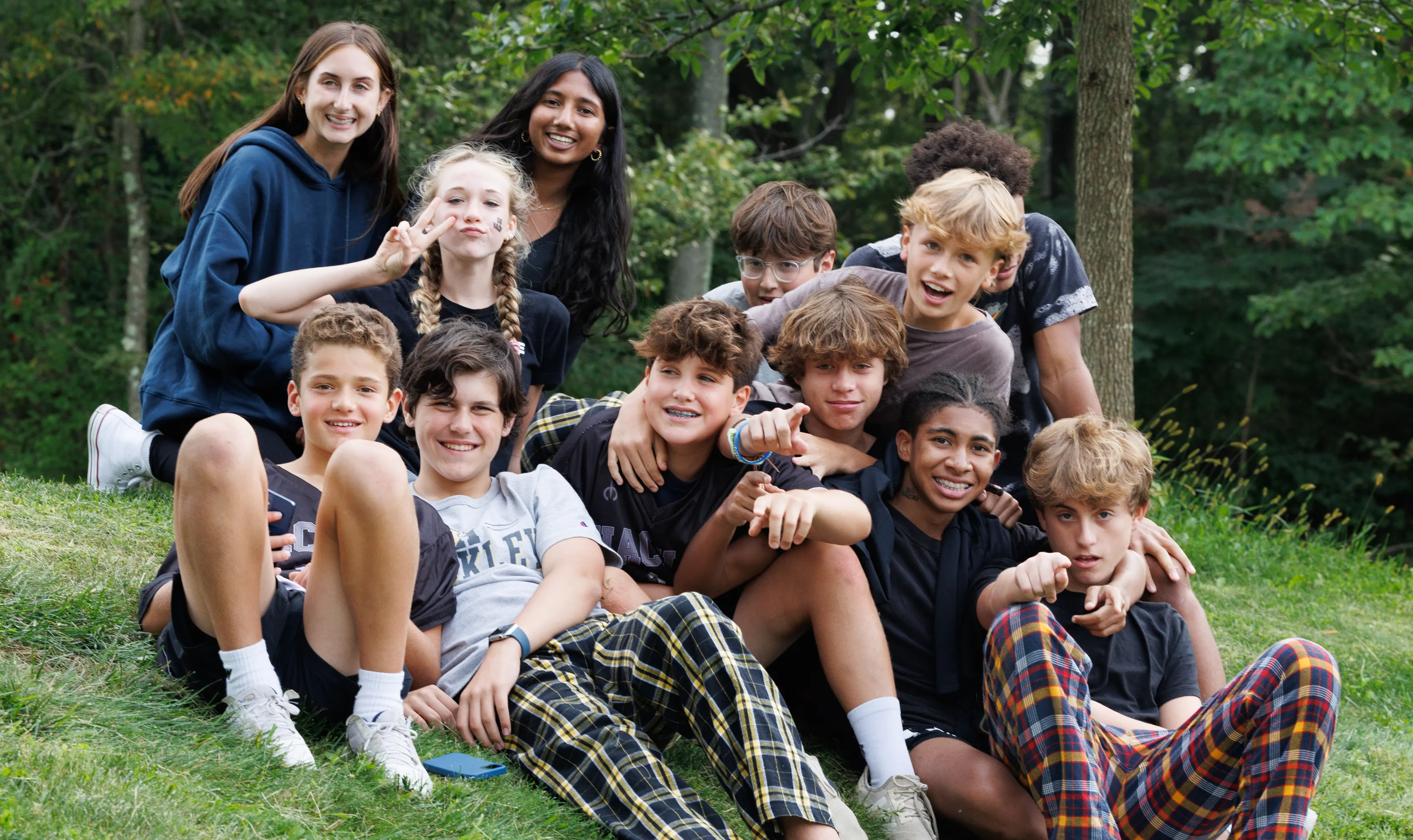
Students pose for a group photo at the 2023 Fall Sting.
We will see how the year ahead plays out. I am anticipating that our policy of no devices in the Lower and Middle Schools will be adhered to and enforceable. I am similarly anticipating that the Upper School students who unconsciously take out their phone when they walk out of a class will reset their cultural habits while on campus and embrace human interactions as their default setting. With that optimistic anticipation also comes a clear-eyed understanding that the addictive nature of phones may be too strong a gravitational pull for us to break free from. Should this be the case, we will look to a more restrictive phone ban to ensure that we achieve our goals of making our Hackley Community one where relationships, engagement and learning are prioritized over everything else.
Finally, it is important we all recognize the societal forces at play in social media use, screen time and smartphone addiction as that leads us away from judging or criticizing the decisions of any community member when it comes to when children receive access to devices and apps. I have the privilege of speaking to a broad range of families, and I often hear a sense of exasperation in trying to hold a line with their children who are asking for a smartphone or access to social media. From their child’s recounting, everyone else in the class has a phone or Instagram or TikTok, etc. and families who want to say no to those requests have to deal with the attendant fear that their child will miss out on social development as a result.
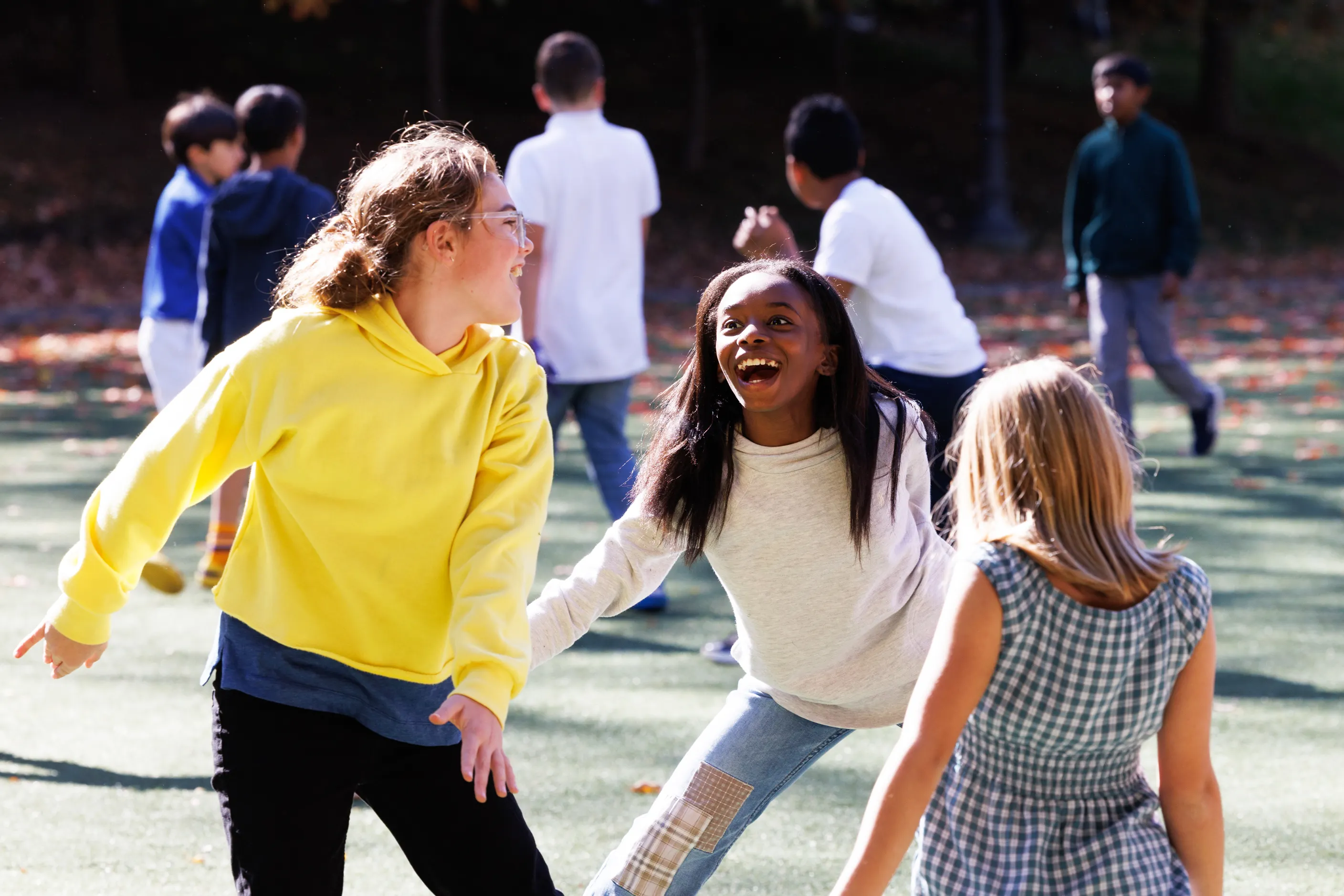
Middle School students enjoy recess on Akin Common.
To all parents, I share the following: there is strength in numbers and so many of you are ideologically heading in the same direction. After I began publicly discussing cell phones and headphones in 2023, countless Hackley parents shared with me that they want to slow down their child’s technology use. This means not giving a smartphone with unfettered access to apps to their Lower or Middle School child. This means providing their child with a flip phone, a Light Phone or a smartwatch as a multi-year Middle School bridge to aid in communication about daily life until Upper School and a possible smartphone.
Note 3: It should also be noted that it is entirely possible for students in all divisions to navigate their time from drop off to pick up without a device and direct access to communicating with a parent. The divisional front offices can communicate any needed message to a student, a tactic we definitively know works, as from the advent of schooling until roughly the mid 2010s, every child in human history had that as their reality.
And it means not providing access to social media until well into a child’s Upper School years. Each family will have their own journey on this front, and my goal here is not to judge or lecture — it is instead to communicate to families that many of your peers are directionally heading toward waiting longer for social media access and smartphones and, should that be your plan, know that you have many fellow travelers on this path.
I look forward to updating our community on our cell phone and headphone policy as the year progresses, and I thank you for all the feedback and support as we all look to provide the best learning environment here at Hackley for our students.
 About the author: Charles Franklin joined Hackley as Head of School in July 2023. Throughout his career in education, Mr. Franklin has focused on building community and creating opportunities for students and faculty.