By Basil Kolani, Director of Academic Affairs, Hackley School
As a recovering educational technologist, I’ve spent my whole career thinking about how technological tools might enhance learning and teaching. I’ve been a little too quick to categorize certain advances as disruptive technologies, but Generative AI (GenAI) is as genuinely disruptive a technology as we have seen.
In a few short years, it has become ubiquitous. Five days after its launch in November 2022, ChatGPT had one million users. To put that in context, it took about 10 years for the internet to have one million users. It took Netflix about 3.5 years to get to one million customers. It took X (formerly known as Twitter) about two years, Facebook 10 months, and the iPhone 74 days. Five days is remarkable, and remember that ChatGPT is just one tool in an ever-growing collection of GenAI applications. (ChatGPT was incredibly helpful in gathering this data and generating title ideas for this blog post.)

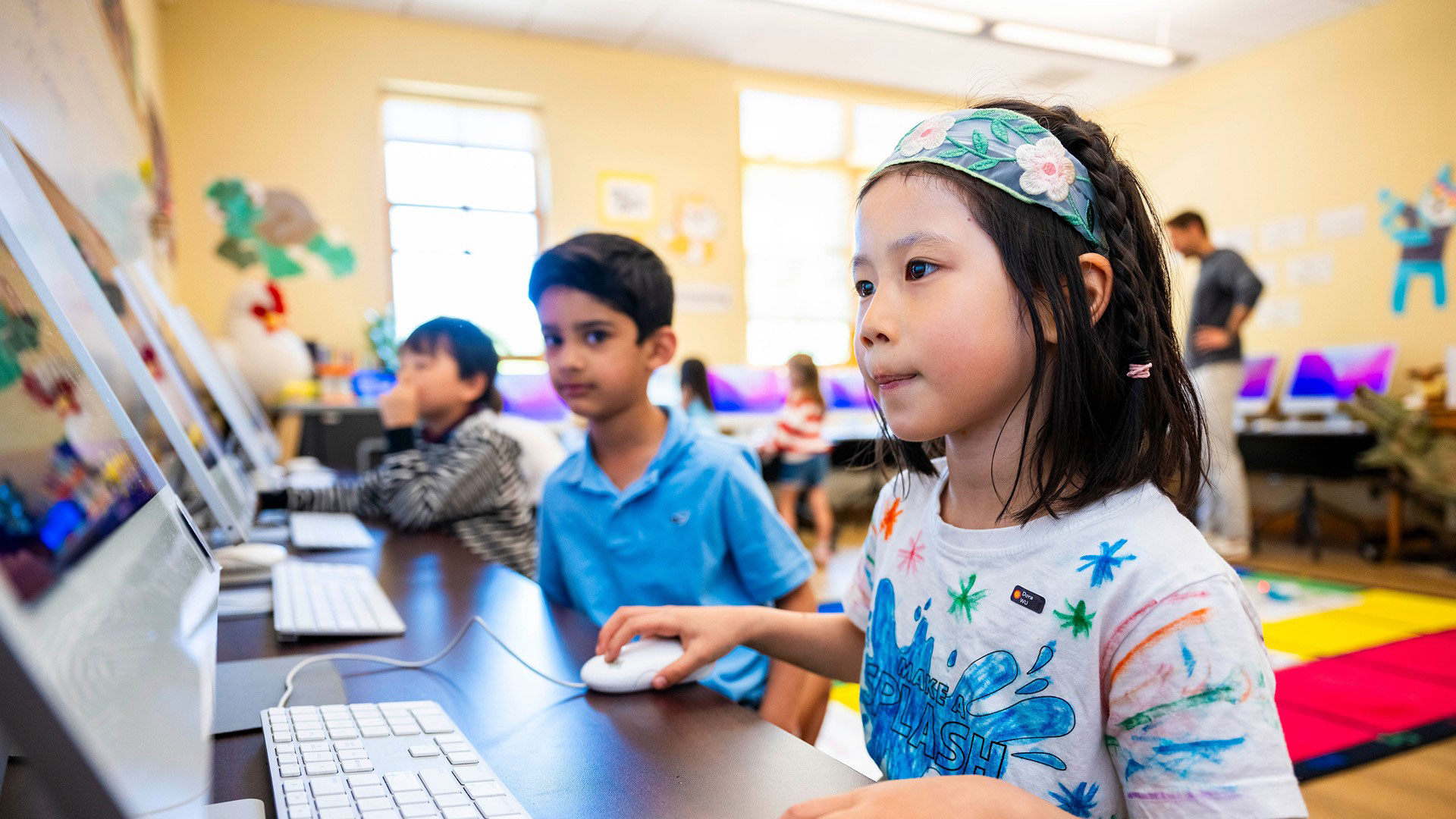
Middle Schoolers work together on a project in their computer science class.
More important than knowing how many people might use one of the many GenAI tools is knowing what they can do. You could use AI to write an email or paper, respond to a writing prompt, create an image or movie, change the reading level of a website, analyze a collection of documents or websites and provide a comparison, or even plan a 45-minute lesson — complete with problem sets — on long division. GenAI might be unable to do these things perfectly or without some intervention or editing to get things right, but it all starts with the right question.
A couple of weeks ago — think of how many technologies might have reached one million users in that time — a poem titled “For a Student Who Used AI to Write a Paper” by Joseph Fasano made its way across my social media feeds. It’s entirely possible that everyone else saw this weeks before me because, as my kids like to point out, my algorithm is usually way behind everyone else’s and too full of (Terrible? Funny? It depends on who you ask.) dad joke memes. Here’s the poem:
Now I let it fall back
in the grasses.
I hear you. I know
this life is hard now.
I know your days are precious
on this earth.
But what are you trying
to be free of?
The living? The miraculous
task of it?
Love is for the ones who love the work.
While I’d take the stark reality of Robert Frost’s “Out, Out — ” over this poem any day (no offense intended to the poet), it is a work very much of its time and reflects many of our general concerns about GenAI use. I hear you. I know this life is hard now. I know your days are precious on this earth. But what are you trying to be free of? When ChatGPT was first available, our immediate concern was what it would do to students’ ability to think freely and to know the craft of writing. The concern wasn’t ever that every student would turn to AI to write all their papers, but instead about the student who felt backed into a corner and needed a way to relieve one pressure to deal with several others. To be fair, that is still a concern, and anecdotal evidence shows that (obviously) students are more adept at using GenAI and are using it in more nuanced ways. We hope that students embrace the miraculous task of creating information on their own and love the work asked of them.
When 1:1 computing and widespread computer usage was a thing that schools were experimenting with, one of the “problems” was Google made it so easy to find the right answers to questions. The solution? Ask unGoogleable questions. Even better, ask students to create, discuss, debate and refine their work so that it could never be reduced to a simple answer. From what I know of learning on the Hilltop, answering a simple question has never been a part of the pact between students and their teachers.
Today, we see students engaging in work that, at the appropriate times, embraces GenAI and at other times is AI-proof. First grade students estimated volume and capacity, visually representing the processes they used to find their answers. In the Upper School, U.S. History students represented delegates to the Constitutional Convention and voted on pieces of the would-be Constitution and the country based not only on the positions of their espoused delegates but also on the strength of arguments and convictions. In another History class, students were given clear guidelines around the expected use of ChatGPT on an assignment, not only using it as a productivity tool but also learning responsible uses of that tool. And, not content with being consumers of content, sixth grade Computer Science students worked on designing and training an AI to provide feedback to an MIT research team designing AI for middle school students; with two members of the research team in their classroom, they designed prototypes of “social robots” after considering the benefits and drawbacks of such creations.

Ninth grade history students used ChatGPT to help craft the curator statement (which was then edited by the students) for their “World History I Museum Project.”
As generally happens with the adoption of disruptive technologies, we began with initial threats to the “right” way to do things; slowly saw how, under the right circumstances, there were useful ways to use the new tool; and now have at least made GenAI use a part of the student experience. Now that we’re here, we have some room for growth. We could make the guidelines and expectations around GenAI clearer and more consistent for students to help them steer clear of academic integrity gray areas. We might consider the possibility of training a Hackley-specific AI to provide students an always-available writing coach to consult before workshopping a piece with their teacher. We should also look across the curriculum to know the possibilities for incorporating GenAI into classwork and assignments. The great news is that so much of this is happening already, and rather than turn a blind eye to GenAI, we know that it is very much shaping the world that we learn and teach in, changing the expectations for students not only here on the Hilltop but in the world they step into once they graduate.
About a year ago, selective memory tells me that nearly every article I read was about the value of teaching students about prompt engineering and that the secret to future success lay in designing the right questions or prompts for GenAI to chew on. We don’t hear as much about prompt engineering a year later, and while I’m sure it is still essential to making the most of GenAI, we might already be working on something more meaningful: actually using what we get out of a GenAI application to make something new. Hackley students are already making new knowledge and creating new understandings. And if, as author Warren Berger shares in his book A More Beautiful Question, good questions led directly to things we take for granted today, like rolling suitcases, Spotify, Cracker Jack and the bar code, we should be thinking about asking better questions that might end up changing the world as we know it. Yes, students will likely start by asking AI to begin their analyses, and that should be celebrated. However, what truly matters is how they use that knowledge to imagine the future — applying the skills of connection, collaboration and creative thinking they learn on the Hilltop. These abilities will be invaluable and could even inspire the next great disruption.
About the author: Basil Kolani joined Hackley as Director of Academic Affairs in July 2022 after working as a teacher, department chair and administrator at independent schools in New York City and Connecticut. He has led teacher training workshops and served as a school visitor and consultant for schools in the United States and Canada for the International Baccalaureate and organized professional development experiences for New York-area teachers. He loves talking about teaching and learning, ’90s alternative and indie music, baseball and, now, where his next travel destination should be.