By Qiong (Katie) Jan, Chinese language teacher, Hackley School
In a classroom buzzing with excitement, seventh grade students carefully lift their calligraphy brushes, tracing the character 想 (xiǎng). Their eyes widen as they discover the hidden heart (心) within its strokes, symbolizing thought and imagination. The gentle scent of ink fills the air, further immersing students in a multisensory experience. Moments like these frequently illuminate our Chinese language classroom, illustrating that learning Chinese isn’t merely memorizing characters — it’s uncovering thousands of years of imagination and cultural stories hidden in every stroke.
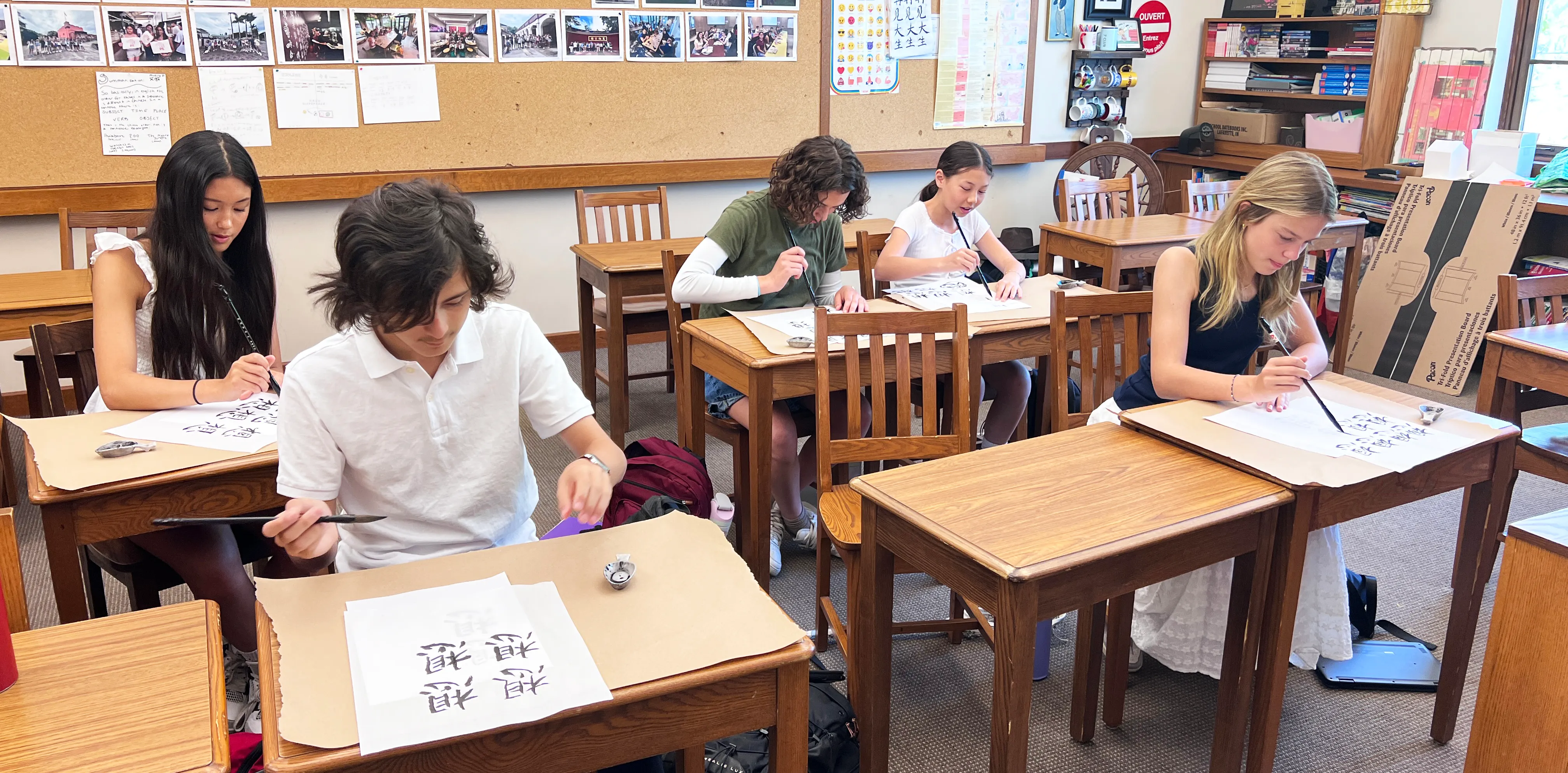
Seventh grade Chinese language students practice calligraphy skills.
The Latin root of “imagination” means “image,” yet the Chinese term 想像 (xiǎng xiàng) provides a compelling new perspective: 想 (xiǎng) means deep, heartfelt thinking, while 像 (xiàng) signifies an image or likeness. When students make these connections, their excitement is palpable as they exclaim, “That really makes sense!” They quickly recognize language as more than words; it’s a vivid map guiding them through ancient traditions, storytelling, and the boundless creativity of generations past.
Confucius wisely observed,
知之者不如好之者,好之者不如乐之者 — To merely know is not as good as to love; to love is not as good as to delight.
Indeed, finding delight in language transforms learning into a joyful journey of cultural discovery.
In our classes, imagination flourishes through such engaging activities as making traditional foods, like dumplings, mooncakes and tanghulu, and watching cinematic masterpieces. Students actively participate in storytelling sessions, crafting their narratives inspired by folklore, debating contemporary cultural issues and collaborating on projects that explore traditional arts, such as paper-cutting, ink painting and origami. These hands-on experiences vividly immerse students in Chinese culture, igniting their curiosity and deepening their cultural understanding.
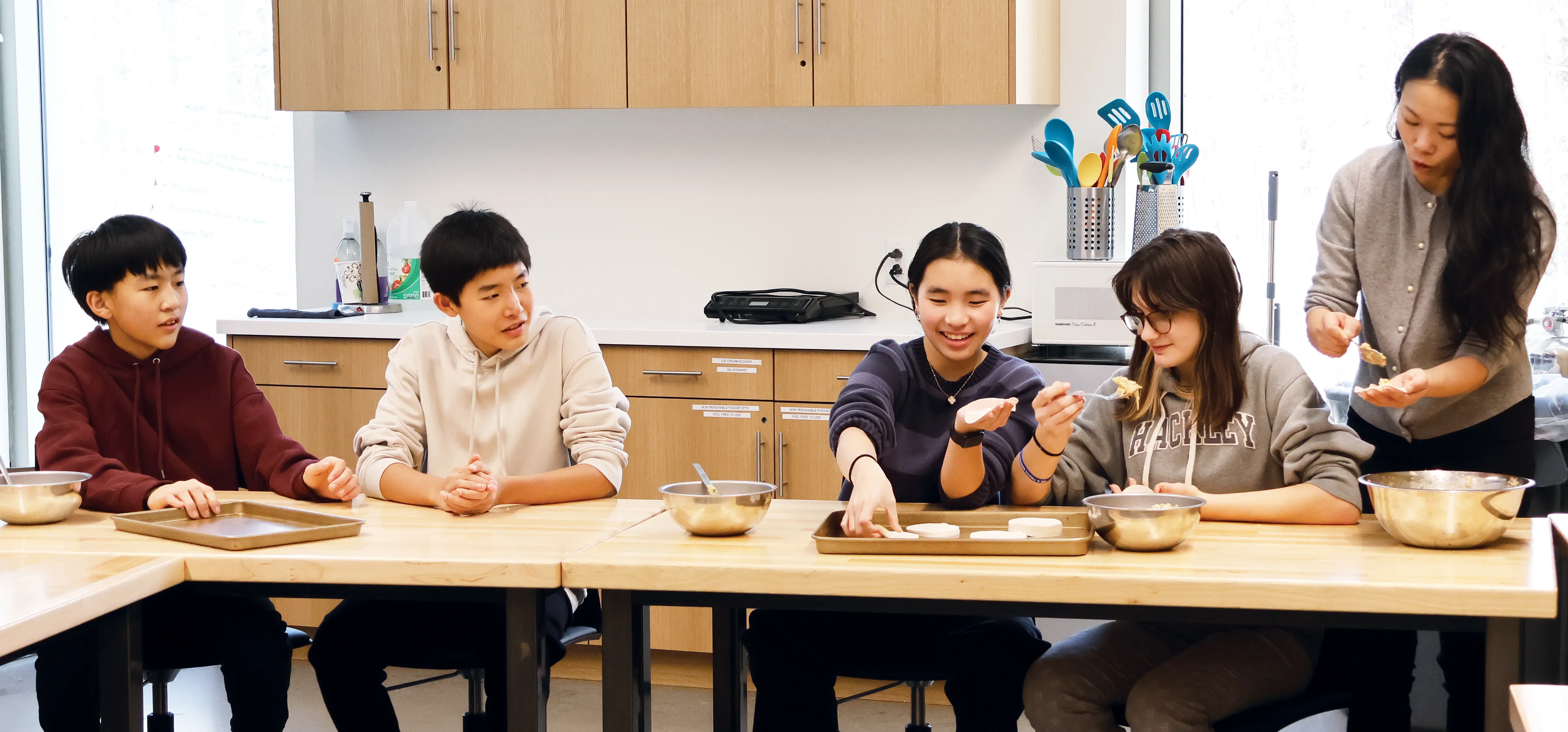
Chinese language teacher Qiong (Katie) Jan (far right) makes dumplings with eighth grade students in the Johnson Center test kitchen.
A particularly memorable event each year is our Chinese New Year celebration, which includes our entire community of Chinese language learners. Students integrate what they have learned throughout the curriculum into preparing performances and cultural presentations, showcasing their cultural inspirations. During the 2025 celebration, students and Chinese Club members enthusiastically embraced traditional dances, proudly sharing them with the Hackley community. Parents eagerly joined in decorating the school, teaching students the art of calligraphy, crafting auspicious red couplets and 福 (fu) characters, demonstrating sugar painting, and serving delicious steamed dumplings. Silk ribbons spun gracefully, red banners shimmered, and joyful laughter resonated through the halls during the festivities. The excitement and joy lingered long afterward, reinforcing the deep cultural connections made. After their performance, students triumphantly exclaimed, “We did it!” These moments vividly showcase the excitement and fulfillment derived from sharing diverse cultural experiences.
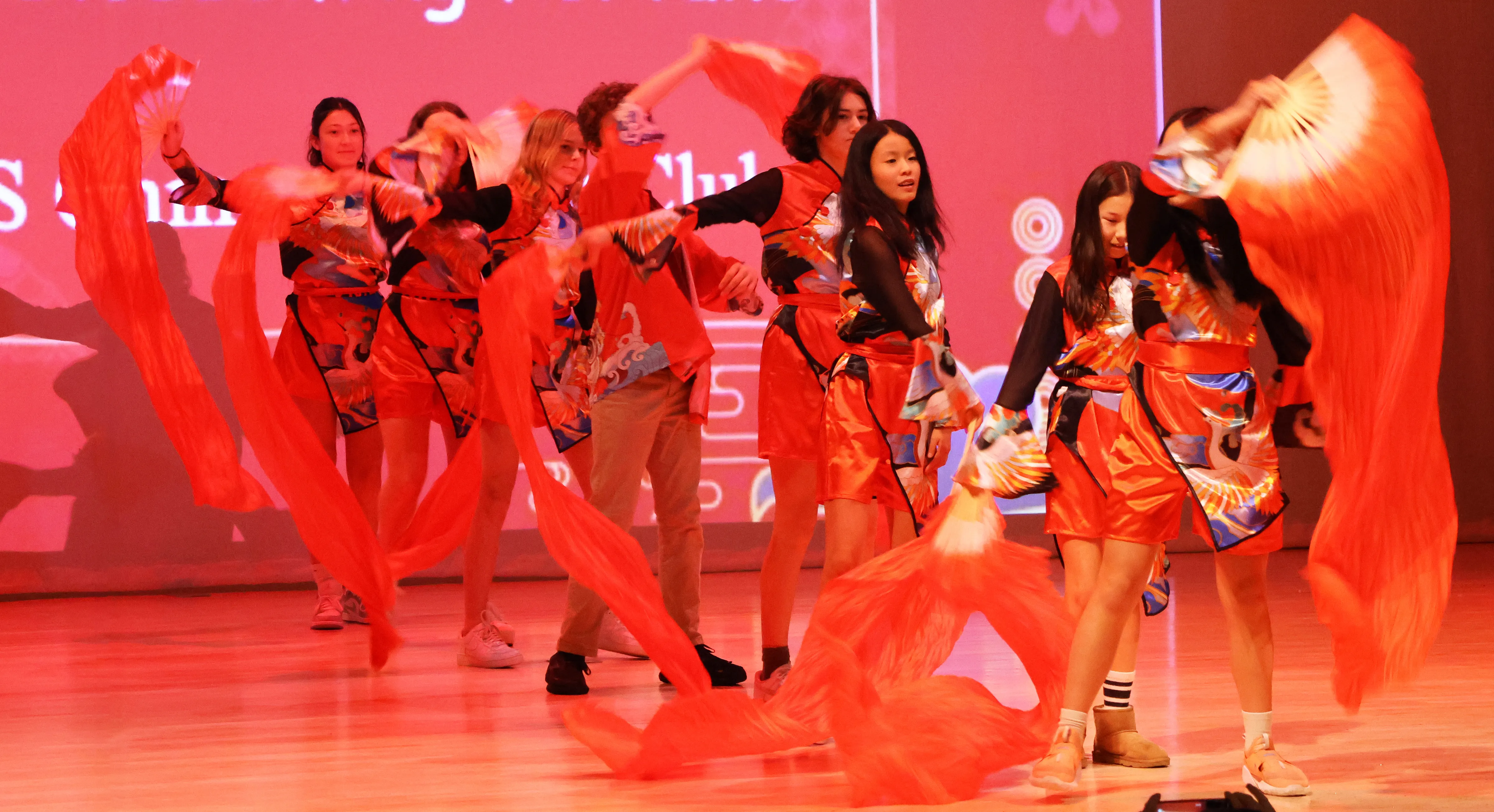
Members of the Middle School Chinese Club perform during this year’s Lunar New Year celebrations.
The Chinese proverb “读万卷书,行万里路” (“Read ten thousand books, travel ten thousand miles”) beautifully encapsulates our educational philosophy, emphasizing the blend of book knowledge with real-world experiences. Inspired by this idea, we launched the 10,000 Mile Trek project, encouraging students to select topics of personal interest, conduct in-depth research, engage with the community, ask insightful questions, and share their findings with peers and faculty. This project nurtures their imagination, fostering creativity, critical thinking, and practical problem-solving in authentic, meaningful ways, profoundly deepening students’ cultural engagement.
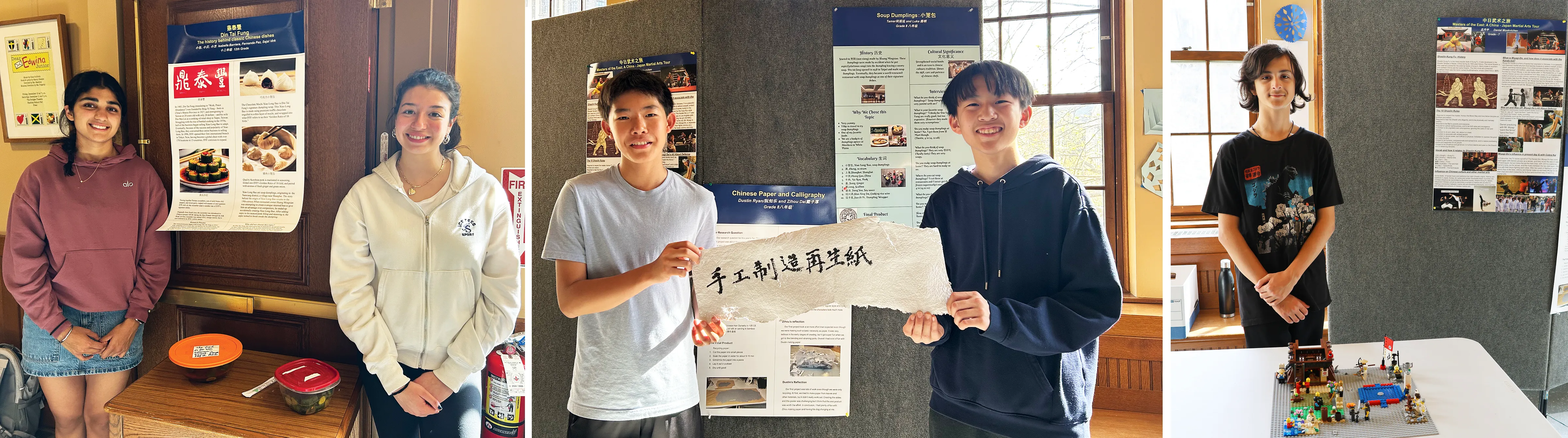
Middle and Upper School Chinese language students showcase their research projects in the 10,000 Mile Trek exhibition in April 2025.
The imaginative spirit fostered by our curriculum was particularly exemplified this year by two ninth grade students, Emerson Pedraza and Cadey Mook. Driven by their passion for Mandarin, they volunteered to teach younger students in the Lower School during their free periods. Witnessing their initial excitement evolve into thoughtful lesson planning and confident teaching, especially as they navigated unexpected challenges, has been deeply rewarding. Such experiences reinforce my conviction that teaching language fundamentally nurtures imaginations, enhances problem-solving skills, and shapes students’ self-perception and future aspirations.
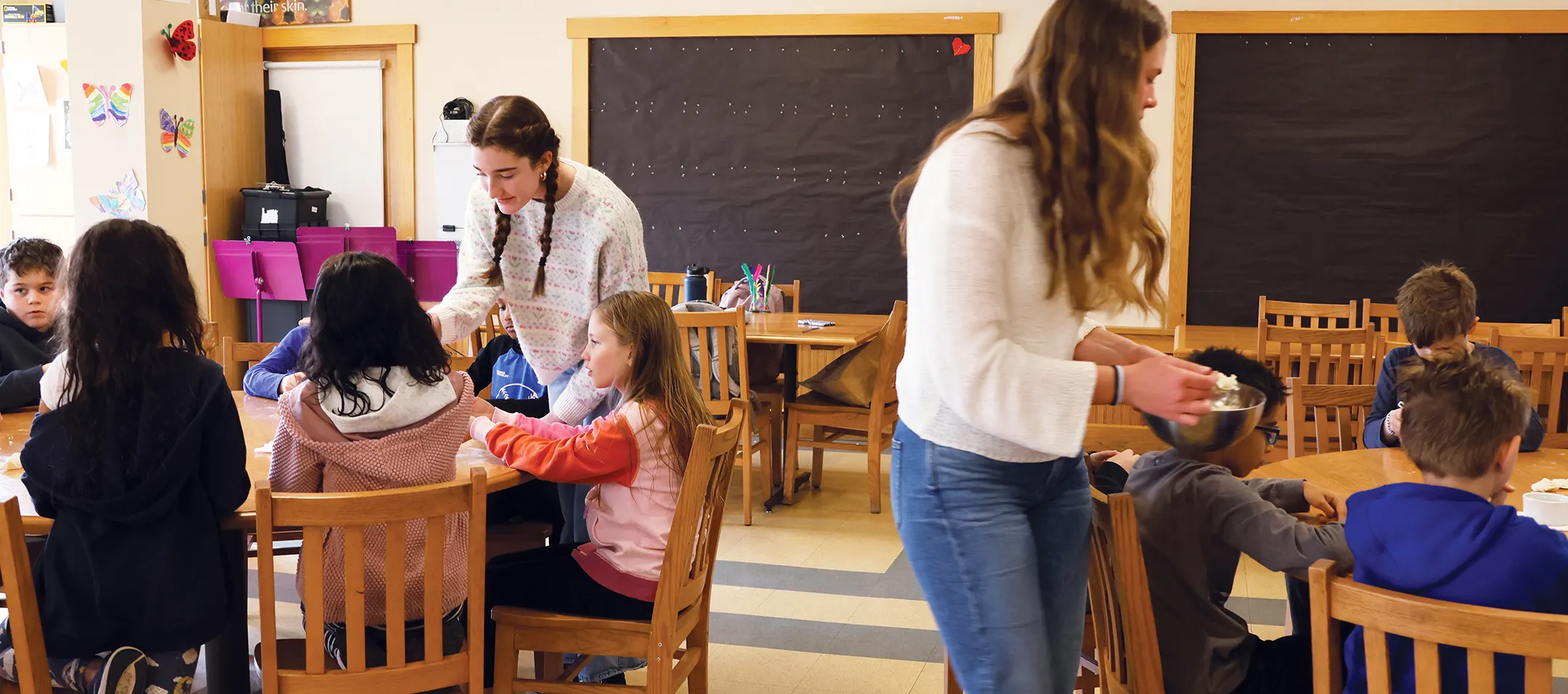
Emerson Pedraza ’28 and Cadey Mook ’28 teach third graders how to make dumplings as a way to promote and drum up interest for the Chinese language program in the Lower School.
Another inspiring moment involved eighth grader Cillian O’Rorke, whose exploration of Deepseek, a leading artificial intelligence company from China, sparked my curiosity and prompted me to learn alongside him. Together, we discovered that incorporating more Chinese characters into Deepseek’s large language models, alongside alphabetic languages like English, significantly boosted their performance. Because Chinese is a logographic language — where each character conveys an entire concept — this combination created a powerful synergy. This fusion of logographic and alphabetic systems enabled Deepseek to process information more efficiently, highlighting the distinct advantage that learning Chinese offers large language models.
Similarly, ninth grader Brady Ahmad drew inspiration from the classic 16th-century novel Journey to the West after encountering its characters in the popular video game “Black Myth: Wukong.” Intrigued by Wu Kong, the rebellious Monkey King known for challenging authority, Brady thoughtfully examined such proverbs as 人不可貌相 (“Don’t judge a book by its cover”) and 飞得越高,越容易被射中 (“A bird that flies high is a target for an archer”). Brady observed how these proverbs cleverly justify characters’ actions, prompting him to draw parallels with modern-day information manipulation. His analysis highlights the enduring imaginative depth and cultural relevance of traditional literature.
Learning Chinese at Hackley goes beyond linguistic skills — it cultivates a comprehensive and imaginative worldview. Our goal is to empower students to engage deeply with cultural diversity, creatively navigate global communities, and potentially shape our interconnected world in innovative and exciting ways. Our journey continues, propelled by curiosity and imagination, as we discover fresh perspectives guided by the endless possibilities embedded in language and culture.
About the Author: Qiong (Katie) Jan is celebrating her sixth year as a member of the Hackley faculty, teaching Chinese language and culture across various grade levels. She is also the proud parent of Hackley students Sophia ’32 and Steven ’35, along with a future Hackley student. With more than 14 years of teaching experience, Qiong is a recipient of the Boettcher Foundation Teacher Recognition Award, honoring educators who profoundly impact their students’ academic and personal growth. Passionate about continuous improvement and innovation, Qiong actively fosters cultural appreciation and language proficiency through teaching Chinese, Chinese Club activities, schoolwide Lunar New Year celebrations and creative student projects. Outside the classroom, Qiong enjoys spending quality time with her family, traveling to explore diverse cultures, and engaging in community activities that promote cultural understanding and exchange.