By Charles Franklin, Head of School, Hackley School
In the fall of 1997, I encountered a setback. In the grand scheme of life, it was a small one, but at the time, it felt significant and disappointing and daunting.
I had started college that fall and was playing for the soccer team. Well, perhaps a more accurate description was that I was on the roster of the soccer team, as I had not seen the field as a freshman for the first half of the season.
On a beautifully crisp Saturday in October, our team took a 3-0 lead early in the second half. Assuming this was a safe enough lead to give a handful of freshmen their first game time, our coach subbed several of us into the game. Around 15 minutes later, he unceremoniously subbed all of us off, as we had given up a number of dangerous chances and a goal to make it 3-1. I took a seat on the bench — where I would remain firmly entrenched for the remainder of the season — and realized this was not how I had anticipated my college soccer career going.
I thought about this moment recently after interviewing a number of candidates for our Middle School Director position. As part of this process, I spoke with a large number of educators from across the country who were interested in the role. Many of these people were sitting middle school directors and all had extensive experience in working with middle school students. They came from schools large and small, urban and suburban, traditional and progressive. Their answers to my questions reflected their diverse backgrounds and experiences, offering different responses to questions about leadership, management and education.
However, whatever their school’s composition or the region they came from, it was striking how similar their answers were to one question:
What attributes do middle school students need most today in order to be successful and how have you worked to promote those attributes?
There are many possible thoughtful answers to that question, and I was anticipating receiving a range of responses. Instead, the similarity of their replies points to an underlying truth that warrants further examination. Each candidate said they think middle school students need the attributes of fortitude and resilience when confronted with the initial signs of struggle, disappointment and challenge. They spoke about how young people today pull back, avoid and disengage when they encounter a bump in the road more so than previous generations. (I must note here that I am usually averse to such proclamations. I think we often overstate whatever cultural or social development we are seeing with today’s young people compared to some anecdotal and rose-colored past that we imagine, and that we understate the timeless aspects of adolescent behavior. But in this case, I think it is true that young people today, in aggregate, do not deal with setbacks as well as previous generations).
To hear middle school leaders across the country state the same thing — that they view one of the most important aspects of their job as helping students see setbacks, failure and challenges as part of a normal adolescent developmental arc — was illuminating. It provided me the opportunity to think about where we have gone wrong in our equation of success for young people.

Coach Franklin with the Middle School Boys Basketball team at Winter Sting January 2026.
In speaking with parents, I often hear them say they want their child to be both happy and successful. These are in and of themselves positive outcomes, and I want these for each of my own children as well. But there is a missing variable in this formula for raising a balanced, motivated, responsible, independent and accomplished young person. When we tell our children we want them to be happy, it risks positing unhappiness as a negative outcome, something to be avoided. And while clinical diagnoses of depression are crucial for families and educators to identify, respond to and care for, I am speaking here more about the general and temporary unhappiness that comes from a low test grade, dealing with the ups and downs of social relationships, getting cut from a team, or not getting a certain role in a musical.
At the same time we are telling our young people that their happiness is of primary importance, we are also telling them we expect them to achieve at a high level. In communities like Hackley’s, being excellent at something is often seen as the coin of the realm. Whether we explicitly or implicitly communicate this message, it nevertheless sinks in to students that they need to be successful in their endeavors. This is a good goal — I would much prefer a community where students are driven to get the most out of their talents than a community where the opposite is the case. The problem arises when these are the only two values we highlight, as it misses the key bridge between happiness and success.
The connector between happiness and achievement for 99% of students is what I’ll term resilience, but you could also call it perseverance, grit, not-giving-up, steel, determination, courage or belief in oneself.
Every now and then in my career I have come across a student who achieved great things without having gone through setbacks. I estimate around a dozen students fall into this category out of the thousands I’ve worked with. For the vast majority of us, the response to challenge defines our growth and eventual success, and it includes periods of being unhappy.
In the fall of 1997, I was unhappy with my soccer experience. As I sat with my unhappiness that off-season, I considered a few options:
- I could complain to the coaching staff that I hadn’t been given a fair shot, that only giving me 15 minutes of game time with other bench players didn’t let them see how I could contribute, and that they should play me more with the starters next season.
- I could quit and devote more of my time to other pursuits.
- I could focus on improving my game and demonstrate to the coaches that I could help the team in ways big and small.
I chose the final option, and with every passing year, I am incredibly glad I didn’t let my unhappiness cause me to disengage, blame others or quit. While I never became a star player in college, I did manage to work my way into the starting lineup. And, more importantly for my life, I realized the value and joy I derived from being part of a team, which helped lead me to my current career.
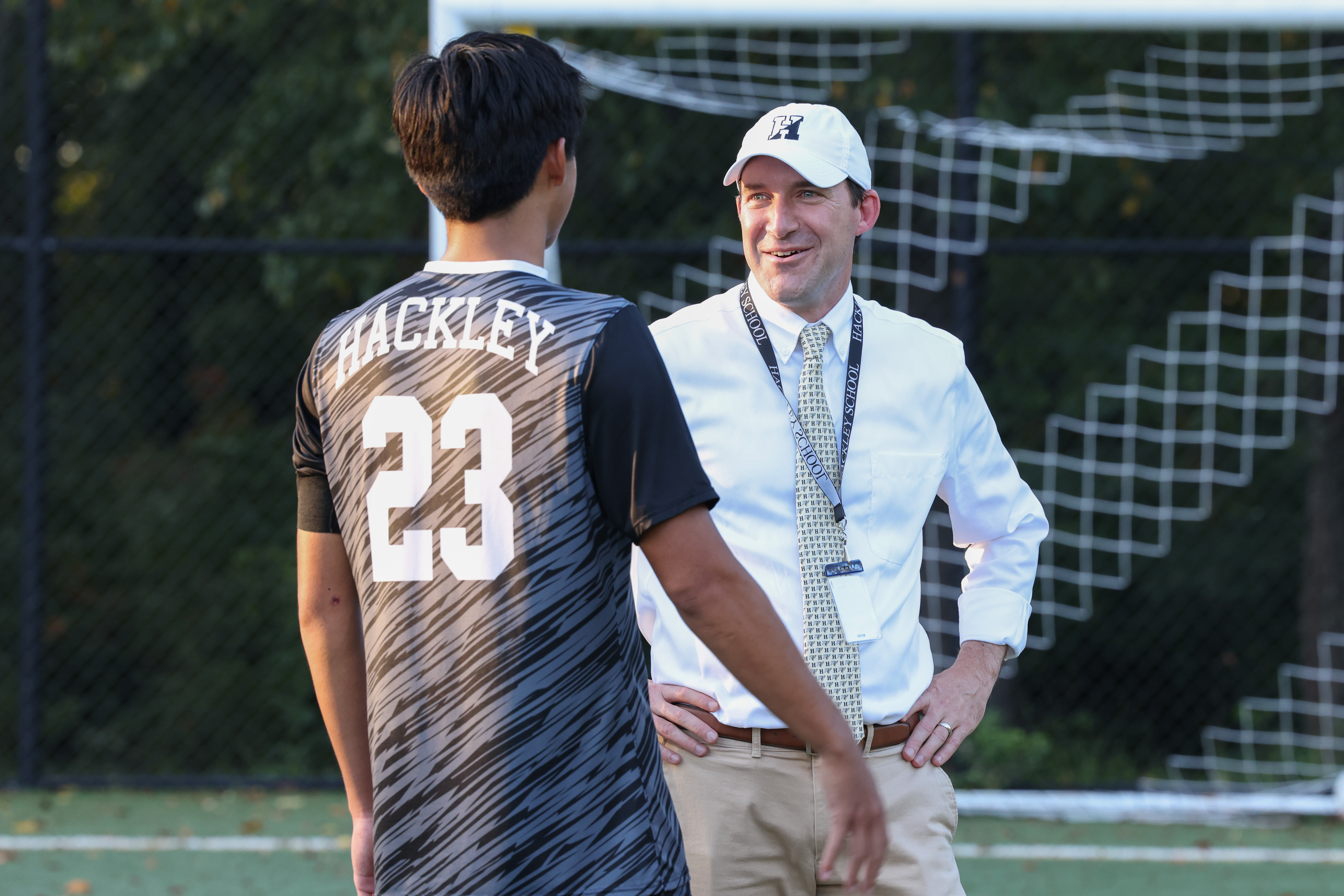
Mr. Franklin connects with the Boys Soccer team early in his career at Hackley.
Looking back, this was a relatively easy decision to make. Today, however, students confront these decisions in a much more challenging environment. When students earn a low test grade, some students (and if we’re being honest, some parents) view it as a death-knell for their entire future. While this is misguided thinking, it is the fatalism inherent in this reaction that bothers me the most. If a 78 on a math test has just ruined my future, then why try harder in math class?
We all want happiness and success for our children, but we forget that struggling through something like seventh grade math class is an indispensable, crucial and developmentally necessary ingredient for later success. Blaming the teacher or diverting energy to other subjects where a student is meeting with more success are both short-term avoidance strategies that cause a young person to miss out on the true and lasting growth that comes from overcoming a challenge. If we want our children to be both happy and successful, we have to guide them through the inevitable periods of unhappiness by teaching them resilience.
So, the next time we as parents express that we want our children to be happy and successful in life, I’d advocate for adding ‘resilient’ to that sentiment to give them a more accurate equation to consider.

About the author: Charles Franklin joined Hackley as Head of School in July 2023. Throughout his career in education, Mr. Franklin has focused on building community and creating opportunities for students and faculty.